


HR / Internship Enquiry
+91 9150222779
.webp)
Zoho Recruit - Bought, Configured and Supported by a Zoho Premium Partner
Zoho Recruit does two jobs at once. It's an applicant tracking system, so candidates, pipelines, interviews and offers all sit in one place. It's also a recruitment CRM, which matters a lot if you run an agency and your clients are as important as your candidates.
We sell you the licence at Zoho's own price. Before you pay, we check you're buying the right edition, because Zoho Recruit comes in two and people get this wrong constantly.
Then we set it up around the way you actually hire, and we're still on the account when the awkward questions turn up in month three.
Thirteen years with Zoho. 1,500+ implementations.
50+ certified consultants. Offices in Chennai and Dubai.
For staffing and recruitment agencies · For in-house talent acquisition teams · India · UAE and the GCC · US and UK

Zoho Recruit is really two products.
Buying the wrong one is the costly mistake.

This is the first thing we check with anyone buying Zoho Recruit, and it's why a phone call before you subscribe is worth fifteen minutes.
There are two editions.
Corporate HR
For in-house talent acquisition teams hiring for their own company.

Manage your company's hiring process

Track candidates, interviews and offers

Collaborate with your hiring team

Build a strong talent pipeline
Staffing Agency
For recruitment firms, search firms and staffing companies placing candidates with external clients

Manage clients and candidate placements

Vendor portals and client collaboration

Formatted resumes
Multi-organisation support
The agency edition adds client management, vendor portals, formatted resumes and multi-organisation support.
Here's the part that catches people. The plan names repeat across both editions, but the limits don't. At comparable price points, the Staffing Agency edition allows far more active job openings than Corporate HR, because that's what an agency needs to function. The tier structures aren't the same either. One edition has a middle tier the other doesn't. So this happens, over and over:
An agency signs up on Corporate HR because it looked like the default option, hits the active-job ceiling in week three, and has to move.
An in-house team ends up on Staffing Agency, paying for client and vendor tools nobody will ever open.
Someone buys the entry tier for the AI features, then finds the AI sits a tier higher.
None of this is hidden. It's published on Zoho's own pricing pages. It just needs somebody to read them against your real hiring volume before you click buy, and that's a free conversation.
The licence costs the same either way.
What comes with it doesn't.
You can buy Zoho Recruit from Zoho's website in a few minutes, and for a two-person team hiring one role a quarter, that's a perfectly reasonable thing to do.
Here's what changes when the licence sits with a partner.

The price is identical
Zoho sets it. We can't mark it up and
we can't discount below Zoho's published rate.
What you're choosing is who's attached to the account.

The edition and tier get decided before you pay.
On Recruit this matters more than on any other Zoho product, for the reasons above.

You find out the real monthly number.
Video interviewing, client portals, extra storage and backup are separate licences. We'll price what you'll actually be billed, not the figure on the pricing page.

You get a named consultant instead of a queue.
Escalations to Zoho go through the partner channel.

You get a straight answer on Zoho One.
If you're also going to use CRM, People, Books and Projects, the all-app bundle is often cheaper than buying Recruit on its own.
We'll run both numbers even when it means selling you less.

And renewals and seat changes become an email rather than a form.
The core of the product

Getting candidates in
Post a job once and it goes out to 75 or more job boards, Linkedin and the major regional ones included, without logging into each separately.
You get a branded careers site on your own domain, so applicants never bounce out to a third-party portal. There's social recruiting and referral routing, plus a Resume Inbox that turns CVs sent to an email address into structured candidate records on its own.

Tracking them properly
Resume parsing turns a PDF into a searchable profile. You build hiring pipelines per role, per department or per client, with as many stages as your process actually has. Interview scheduling, feedback capture and video interviews are built in, and it carries through to offer and placement. Over time the candidate database stops being a folder of files and starts being something you can search.

The AI, and the caveat
Zoho has pushed hard on AI here. Zia can draft job descriptions, help with sourcing and screening, run assessments, summarise candidate profiles, score candidates in context and draft candidate communication. One thing to know before you buy: the AI is tier-gated. If Zia matching is the reason you want Recruit, you need to be on a tier that includes it. We'll make sure you are.

Reporting
Dashboards on pipeline health, source effectiveness, time-to-hire and recruiter performance, all exportable.

What Zoho Recruit connects to
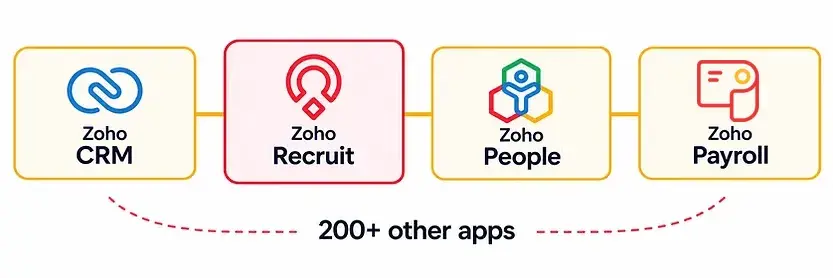
A hired candidate becomes an employee record in Zoho People without anyone re-typing anything, then gets paid through Zoho Payroll on the same data.
If you're an agency, your client-side business development belongs in Zoho CRM.
Beyond that there are 200+ apps in Zoho's marketplace covering background checks, assessments, communication and calendars, plus the usual outside connections to Slack, Linkedin, Outlook and accounting tools.
Staffing agency software, for when the agency is the business
If you place candidates with clients rather than hiring for yourself, the Staffing Agency edition was built for you, and it's the edition most agencies should be on.


Client management
Clients, contacts, job orders and requirements as proper records, not fields you've bent into shape.

Client portals
Your client reviews the shortlist, leaves feedback and approves candidates without a forty-message email thread.

Vendor management
For agencies working through sub-vendors and partner suppliers.
Formatted resumes
CVs come out in your template and your branding before the client sees them.

Multi-organisation support
For separate brands, entities or geographies under one roof.

High active-job limits
Which is the practical difference between the editions.

Submission and placement tracking
across the whole client lifecycle.
Corporate HR,
for hiring into your own company
If you're an internal TA or HR team, Corporate HR is your side of the product, and the value sits somewhere different.


You get one candidate database instead of a shared mailbox and three spreadsheets.

Requisitions get raised, approved and tracked properly, so nobody starts recruiting for a role finance hasn't signed off.
Hiring managers leave scorecards and feedback inside the system rather than in reply-all.

Your careers site sits on your domain and feeds straight into the pipeline.
Interviews get scheduled against real calendars. And your time-to-hire and source-of-hire numbers hold up when somebody asks where they came from.
The real reason to pick Recruit over a standalone ATS usually isn't the feature list. It's that the person you hire flows into Zoho People and then Zoho Payroll with no CSV and no re-keying. One data model, one vendor, one support relationship. If you already run Zoho, that argument tends to end the conversation. If you don't, it's weaker, and we'll tell you so.

Zoho Recruit for India,
where the hiring volumes are real
India is the biggest Zoho Recruit market in the world and it's our home market.
The reason is structural. India runs an enormous IT staffing and contract-recruitment industry, and hiring volumes here break tools designed for ten roles a quarter.
This is where our time goes on Indian implementations.


Volume and bulk hiring
Pipelines that still work when there are four hundred candidates against one requisition, not forty.

Campus and batch hiring
Cohort intake, assessment rounds, bulk status changes and offers rolled out together rather than one at a time.

Contract and IT staffing
Client requirements, submission tracking, rate cards and margin visible per placement, which is the number your business actually runs on.

Multi-location hiring
Across offices and states, with visibility rules so consultants see their own requisitions and not everyone else's.

The handover
Offer accepted, employee created in Zoho People, salary structure applied, statutory setup right, first payslip correct. That last mile is where most ATS projects quietly fail.

We're in Chennai
For Indian clients that means the same timezone, someone on site when it genuinely helps, and consultants who've seen your industry before.
Zoho Recruit for the UAE, where hiring doesn't end at the offer
Recruiting in the Gulf carries two problems that ATS platforms elsewhere never have to solve. Your workforce is a mix of nationalities with different rules attached, and people's right to work depends on documents that expire.

What we configure for UAE and GCC clients

Agencies placing into the GCC
On the Staffing Agency edition, with client portals for employers who want to review shortlists themselves.

Multi-nationality pipelines
Visa category, nationality and availability captured as structured fields, because they decide who can actually be placed.

Mobilisation tracking
An accepted offer isn't the end here. Visa, medical, Emirates ID and onboarding are, and someone needs to be able to see where each one is.

Document expiry alerts
Carried into Zoho People, so passports, visas and labour cards stay tracked long after the hire.

Blue-collar and bulk mobilisation
Where volume is high, document quality is poor and candidates are sourced offshore.

Free zone versus mainland
Differences reflected in the workflow rather than remembered.

English and Arabic
Across everything a candidate sees.
The handover
Which in the UAE is the bit that hurts if you get it wrong: hired candidate into Zoho People, salary into Zoho Payroll with WPS and gratuity already set up.
Recruit works the same everywhere.
The fit is what changes.
Zoho Recruit is a global product and we implement it for clients in the US, UK, Canada, across Africa and around Southeast Asia.

It's a good fit if
you're a staffing agency or an SMB-to-mid-market in-house team, you want a capable ATS at a sane cost per recruiter, and you either already run Zoho or you want to.

It's probably not if
you need a heavy enterprise TA suite with deep compliance tooling like OFCCP-style reporting and complex EEO workflows, if you want a large built-in sourcing database to prospect from, or if you're an enterprise standardised on a global HCM.
Recruit is a strong ATS and recruitment CRM. It isn't a proactive candidate-sourcing database, and we'd rather say that now than three months into a project.
We'd genuinely prefer to qualify you out on the first call.

The boundary, stated plainly
Zoho Recruit covers the hiring lifecycle well. Some things sit outside it, and pretending otherwise would waste your money and our time.
Timesheet-based contract staffing is the big one: placed contractors submitting weekly timesheets, a client approving them, and those hours driving both the client invoice and the contractor's pay. Complex margin, split-commission and sub-vendor billing across several entities is another. So are mobilisation workflows that need their own approvals and audit trail, and client-specific compliance packs that have to be assembled and signed before anyone starts.
Where that's your situation, we build the missing layer on Zoho Creator and wire it to Recruit, Zoho Books and Zoho Payroll instead of replacing any of them. We've built this kind of custom layer for other Zoho products already, including a UAE payroll application on Creator that generates WPS/SIF files.
It's a service we deliver, not something we're promising to try.
At discovery we'll tell you whether your requirement is a configuration job or a development job. Those are very different quotes, and you should know which one you're getting before you commit.

Recruit, People and Payroll are one chain, not three purchases
Most ATS buyers hit the same wall eventually. The ATS knows about candidates. The HR system knows about employees. Nothing connects the two except somebody exporting a spreadsheet on the last Friday of the month.

Running Recruit alongside Zoho People and Zoho Payroll deletes that step. Candidate accepts the offer, the employee record appears with the data you already captured, the salary structure applies, the country's statutory setup applies, and the first payslip is right.
We implement all three. That means one team owns the whole chain and there's no second vendor to point at when the handover breaks.
If you're buying Recruit and you think you'll need HR and payroll inside a year, say so now. It changes the architecture, and often the licence route. → Zoho One
How Zoho Recruit is priced
Zoho Recruit is priced per recruiter, per month. What you pay depends on three things: which edition you're on, which tier inside that edition, and which add-ons you need.
We don't publish figures on this page, and there's one reason for that. They change, and a stale number on a partner's website is worse than no number at all. Ask us and you'll usually have the current price for your edition, tier, seat count and country in writing the same day.

Four things worth knowing before you ask.

Edition first, price second.
The two editions differ far more in limits than in headline rate.
Get this wrong and the cheap plan turns into the expensive one.

The Al is tier-gated.
If Zia candidate matching and AI assessments are why you're buying, confirm the tier includes them before you commit.

Add-ons are separate licences.
Video interviewing, client portals, extra storage and backup all bill on top. The realistic monthly figure is the one that includes them, and that's the one we'll give you.

The free plan is a demo.
One active job, no resume parsing, no AI, no integrations.
Fine for a look. Not something a working team can run on.
What we actually do when you hire us to implement it

Discovery, week one
Agency or in-house, hiring volume, roles, countries, current system, current pain, and who needs to see what. You come out of it with a written scope, the right edition and tier, and a fixed price.
If the job needs Creator development rather than configuration, this is where we say so, not later.

Configuration
Pipelines and stages, requisition and approval workflows, user roles and record visibility, email and interview templates, scorecards and assessments, plus client and vendor setup if you're an agency.

Careers site and job boards
Branded careers site on your domain, application forms that capture what you need rather than what the template offered, and every job board channel connected and proven with a live posting.

Data migration
Candidates, resumes, clients, job orders, historic placements and notes. The resume files and their parsed data both. This is the step self-implementations underestimate every single time.

Integration
Zoho People and Zoho Payroll for the hire-to-pay handover, Zoho CRM for agency business development, and whatever calendars, email, assessment tools and background-check providers are in scope.

Training and handover
Recruiter training, then a separate shorter session for hiring managers, because they won't sit through the long one. Written runbooks either way.

Coming off another system, or off spreadsheets
Most of our Recruit projects are migrations. What we handle:

Candidates and resumes
Records and the underlying files, re-parsed so search works properly in the new system rather than returning nothing.

Client, contact and job-order history
For agencies.

Historic placements and submissions
So your reporting has a baseline from day one instead of starting at zero.

Notes, activity history and attachments
This is the institutional memory your consultants rely on and it's the thing people forget to ask for.

Duplicate detection and cleanup
Done at migration because it's the only convenient moment you'll ever get.

A reconciliation report
Showing what came across, what didn't, and why.
Thirteen years, 1,500+ Zoho implementations, two offices

Zoho Premium Partner
The top partner tier, held for thirteen years.

1,500+ Zoho
implementations
Since 2013.

50+ certified
Zoho consultants
In-house.

Chennai and Dubai offices
So India and GCC clients get someone in their own timezone.

We implement the whole HR chain
Recruit, People and Payroll, which means nobody's pointing at the other vendor when the handover breaks.

We build as well as configure
Zoho Creator development where the standard product genuinely doesn't reach.

We stay.
Most of our clients are still with us years later on support retainers, not one-off projects.
Get the right edition and the right setup from the same people
Tell us whether you’re an agency or hiring in-house, how many recruiters you have, and where you hire. We’ll come back with the correct edition, the current price, and a straight view on whether you need us for the implementation or whether you can handle it yourself
+91 9159045198 +971 52 496 9378 sales@linztechnologies.com
Zoho Recruit FAQ
Corporate HR is for in-house teams hiring into their own organisation. Staffing Agency is for firms placing candidates with external clients, and it adds client management, client and vendor portals, formatted resumes and multi-organisation support. The difference that matters day to day is the limit on active job openings, which is much higher on the Staffing Agency edition at a comparable price. Choosing wrong is the most common and most expensive mistake buyers make.
No. Zoho sets the licence price and it’s the same either way. What you get in addition is a named partner on your account for edition selection, configuration, escalation and renewals.
Both. It handles applicant tracking, so pipelines, resume parsing, interviews and offers, and it handles the CRM side too: clients, contacts and job orders if you’re an agency, long-term candidate relationships if you’re in-house.
Yes. Zoho’s AI assistant Zia can draft job descriptions, help with sourcing and screening, run assessments, summarize candidate profiles and match candidates in context. Which AI features you get depends on your plan tier, so confirm the tier before buying if AI is central to your decision.
Zoho Recruit posts to 75 or more job boards, and integrates with over 200 applications through Zoho’s marketplace.
There’s a free plan, but it’s capped at one active job with no resume parsing, no AI and no integrations. Good for evaluating the interface. Not a plan a working team can run on.
Yes. We migrate candidate records and resume files, client and job-order history, historic placements, notes and attachments, and we clean up duplicates while we’re in there. Migration is a defined stage of our implementation, not an afterthought.
Yes, and it’s one of the better reasons to choose it. A hired candidate becomes an employee record in Zoho People and flows into Zoho Payroll without re-keying, so the offer, the employment record and the first payslip all sit on the same data.
Yes, and it’s one of the most common Indian use cases we work on: campus intake, batch assessments, bulk status updates and offers rolled out together. Configuring for volume is a different job from configuring for ten roles a quarter, which is a lot of what implementation is for.
Most clients move onto a support retainer covering new users, new pipelines and clients, reporting changes, and the questions that only appear once real hiring is running through the system. Zoho support